OK, this is a lazy post.
Popular Science's Most Amazing Medical Images.
Some of these are cheesy, others touching, and others very, very cool.
This is pretty cool just from an experimental setup standpoint. I briefly worked in a neuroscience lab where we had mastered how to image clusters of neurons in genetically engineered mice -- every time the neuron was activated, it fluoresced, and we could see local-scale firing patterns. The problem was being able to do this while the mice ran in mazes, etc. We used fiber optics, but they would often either pull the tube out of their heads or push it further in and kill themselves. This solution reminds me of the "locomotion compensator," invented by Ernst Kramer and Peter Heinecke in the 70's to track insect movement. (Can't find the original article but here are articles that cite it.) Insert joke here about "reinventing the sphere."
Showing posts with label neuroscience. Show all posts
Showing posts with label neuroscience. Show all posts
Monday, October 19, 2009

Monday, September 28, 2009
Santiago Ramon y Cajal
I have a folder of "heros" in my browser bookmarks, people whose life stories remind me that truly anything is possible for an individual. One of them came up this week in our primer to neuroanatomy: Santiago Ramon y Cajal. He was an amazing turn-of-the-century scientist who greatly advanced our knowledge of cerebral microarchitecture. An artist as well as a neuroanatomist, he carefully sketched hundreds of neurons before making a detailed depiction of the "archetypal" neuron of that type. Like many great scientists, he was precocious and bull-headed--my favorite story about his life is that he destroyed the gates of his small Spanish town with a homemade cannon at age 11.
Among numerous scientific articles and textbooks, he also wrote a short book called "Advice for a Young Investigator". The title seems to be a rip off of Rilke, but that was a later publisher's creation. The original title translates directly as "Precepts and Counsels in Scientific Investigation: Stimulants of the Spirit"... a bit unwieldy. However, the book really can be seen as the scientific version of Rilke's "Letters to a Young Poet": it is the sage advice of a elder practitioner on how to navigate an emotionally taxing profession. Some of it is a bit outdated; one section includes advice on how to pick the appropriate scientist's wife. It also has an interesting chapter on "Diseases of the Will", cataloging the various personality types that will fail at science: the megalomaniacs, the overly fastidious, etc. (Read it and see who comes to mind...) However, most of it is very wise, ("because science relentlessly differentiates, the minutiae of today often become the important principles of tomorrow") and occasionally it is very beautiful and inspiring: "I believe that all outstanding work, in art as well as in science, results from immense zeal applied to a great idea." Recommended reading for scientists young and old.
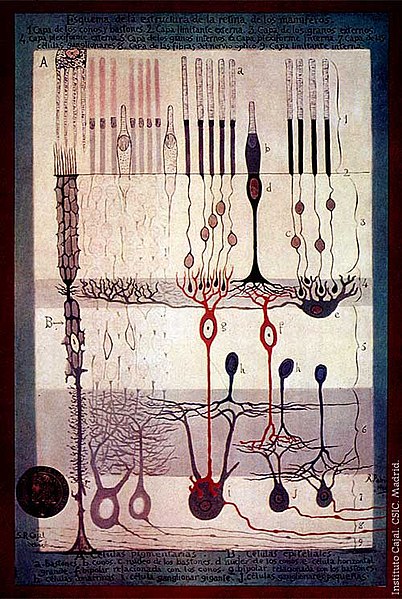
Among numerous scientific articles and textbooks, he also wrote a short book called "Advice for a Young Investigator". The title seems to be a rip off of Rilke, but that was a later publisher's creation. The original title translates directly as "Precepts and Counsels in Scientific Investigation: Stimulants of the Spirit"... a bit unwieldy. However, the book really can be seen as the scientific version of Rilke's "Letters to a Young Poet": it is the sage advice of a elder practitioner on how to navigate an emotionally taxing profession. Some of it is a bit outdated; one section includes advice on how to pick the appropriate scientist's wife. It also has an interesting chapter on "Diseases of the Will", cataloging the various personality types that will fail at science: the megalomaniacs, the overly fastidious, etc. (Read it and see who comes to mind...) However, most of it is very wise, ("because science relentlessly differentiates, the minutiae of today often become the important principles of tomorrow") and occasionally it is very beautiful and inspiring: "I believe that all outstanding work, in art as well as in science, results from immense zeal applied to a great idea." Recommended reading for scientists young and old.
Subscribe to:
Posts (Atom)